Volvo's autonomous haul trucks pass 3 million tonnes as robotaxi scaling stalls
Volvo Autonomous Solutions said last week that its driverless haul fleet crossed 3 million tonnes of material moved, with the milestone logged at Boliden's Garpenberg mine in Sweden, according to Electrek. The same week, a Cox Automotive study found robotaxi awareness at 70% nationally in the US but actual usage at just 18%.
 Peter LindqvistSport, cars and travel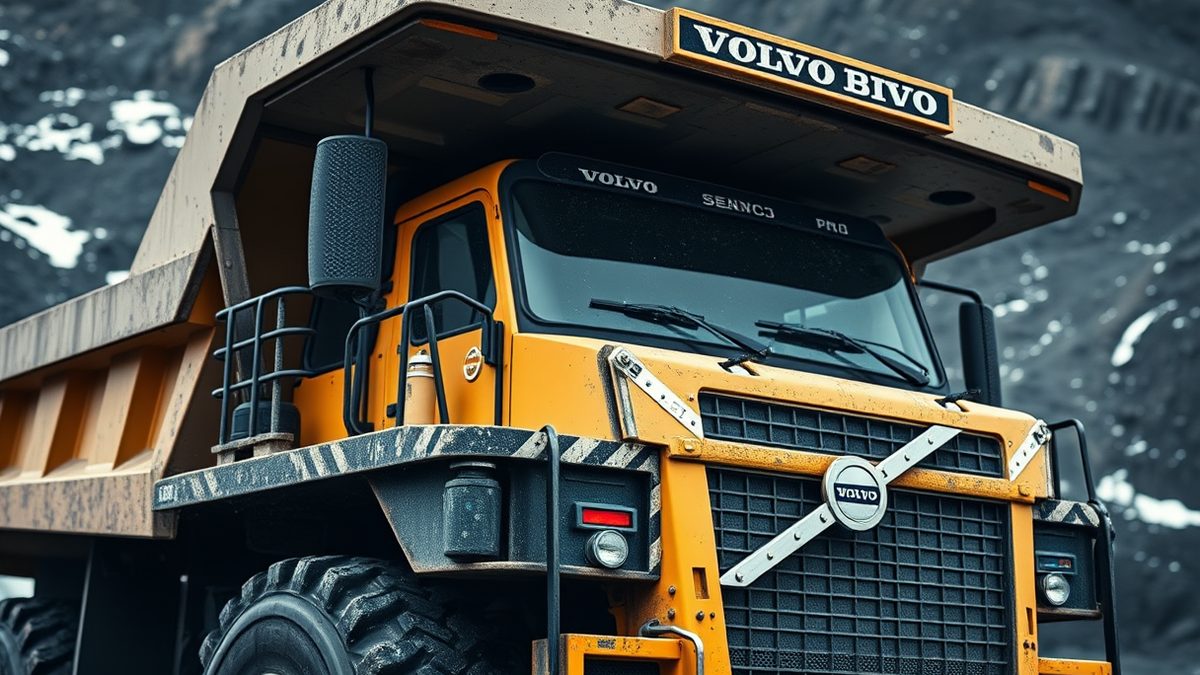
The truck count is not the point. The 3 million tonnes is. And the fact that the milestone was reached at a working mine, not a test track. Electrek reported on 28 September that Volvo Autonomous Solutions (VAS) announced the mark last week, describing it as the point where its ultra heavy-duty trucks and mining equipment hauled their three-millionth tonne without a human driver.
Volvo's first pilot-ready autonomous hauling deployments went to Boliden Garpenberg in Sweden and Brønnøy Kalk in Norway back in 2023, with a one-million-tonne milestone claimed by 2025, per Electrek. By Volvo's own account, the three-million mark was actually crossed at Garpenberg earlier this summer, and only announced last week.
"Reaching three million tonnes hauled autonomously is an important milestone that demonstrates the maturity of our autonomous transport solution and the value it delivers in customer operations," Ingo Stürmer, VAS' CTO, said in the announcement. Electrek quotes him saying the result reflects "years of close collaboration" between the Volvo team and its customers.
Mines first, cities later
Why does a haul truck story sit at the centre of an autonomy piece? Because that is where the arithmetic currently works. Electrek makes the argument directly: the strongest economic case for electrification and autonomy tends to sit in industrial and logistics applications where vehicles follow fixed routes, burn enormous amounts of energy and run around the clock. Every gallon of diesel displaced converts into a measurable saving, which is a cleaner justification for a large self-driving spend than most consumer pitches.
Volvo's product framing follows the same logic. The company calls the line "Autona / earth" and markets it as a complete factory-assembled hauling solution, bundling trucks, software, on-site infrastructure and operational support into a single service. The pitch to a quarry or a mine is that it does not need to become an autonomy specialist to deploy one. Electrek notes Volvo's own confidence in the progress, and the announcement came with new equipment photos.
That is a materially different sales problem from the one robotaxi operators face. A mine is a closed site with known routes, controlled access and a customer who already understands heavy equipment. A city is none of those things.
Which brings us to the harder half of the market.
Cox Automotive published its 2026 Autonomous Vehicle Study on 28 September, ten years after it first surveyed American attitudes on the subject. The headline numbers are a study in asymmetry. Familiarity with autonomous vehicles rose from 40% in 2016 to 58% in 2026, and 46% of consumers now expect fully autonomous vehicles at some point in their lifetime, up from 37% in 2021.
But when Cox asked about ownership, consumers moved the other way. Interest in Level 4 autonomy, defined in the study as full autonomy with the option for a human to drive, was selected by 28% of respondents, down from 30% a decade ago. Interest in fully driverless Level 5 vehicles fell from 17% in 2016 to 10% in 2026. Ownership of Level 2 and Level 3 vehicles nearly tripled over the same period, from 12% to 34%.
"The auto industry has always had longer adoption curves for new technologies," said Vanessa Ton, senior manager of Market and Customer Research at Cox Automotive. "Even hybrid vehicles, which have been available to U.S. consumers for more than 25 years, account for only about one in five new-vehicle sales today. For autonomous vehicles, safety concerns and high-profile incidents have slowed progress, but the growing acceptance of robotaxis seen in this year's study indicates that attitudes are clearly evolving."
The usage gap is the whole story
Cox found robotaxi awareness at 70% nationally and 89% among residents of cities where autonomous services operate. Actual usage sits at 18% nationally and 33% among those city residents. Fifty-five percent of Americans say they are open to using robotaxis, and 61% of non-users cite discomfort with having no human driver as the main barrier.
Read those two figures together and the constraint is availability, not appetite. Cox also reports that Waymo claims roughly 2 million robotaxi rides per month in the US. Note the sourcing: that is Waymo's own count as relayed by Cox, not an independently audited number, and Cox does not break out how it was measured.
Independent trackers are less generous about the field as a whole. The Road to Autonomy Robotaxi Index, a live composite, put Waymo at 84.5 and Baidu Apollo Go at 80.9, with WeRide at 76.1 and Pony.ai at 67.2. Volvo Autonomous Solutions sits at 38.4, unchanged. Tesla's reading on that index was 57.8, up 8.8 over the seven days shown, while Kodiak fell 7.2 to 49.8 and Waabi dropped 6.1 to 32.6. The index does not publish a methodology alongside the scores, so treat the levels as directional rather than precise.
Then there is the part nobody wants to fund. Writing for The Robot Report on 26 September, Dan Keene, co-founder of Aseon Labs, laid out the servicing arithmetic that sits behind every fleet expansion. Waymo is in 14 cities; Uber is in more than 15,000 and did 3.9 billion trips last quarter, processing Waymo's entire weekly ride volume every 17 minutes by Keene's calculation.
His argument is that vehicle reset, not driving software, is the bottleneck. A robotaxi that finishes a ride and finds a spilled drink on the back seat can drive up to 15 miles empty to a central depot to be cleaned, charged and inspected, at roughly two hours per reset. Keene cites California data showing that of 86 million Waymo miles reported through 2025, only 54% carried a passenger.
The constraints he lists are land, time and variance. Industrial-zoned powered parcels are being outbid by data centre developers. California's regulator targets six months just to energise a standard charging site, while a new circuit runs 1.9 years, a substation upgrade 2.8 years and a new substation 8.9 years, per city. And no single depot design fits Phoenix sprawl, Zurich's medieval street plan and Riyadh's heat and dust. Keene discloses that his own company is building a robotic charging, cleaning and inspection station designed to go live within a day, so his argument arrives with a commercial interest attached.
Cox's finding that experience overcomes scepticism is the counterweight. The vast majority of robotaxi users in its study said the experience improved their perception of the technology, which is the strongest argument for putting more cars on more streets rather than fewer.
Meanwhile, in China
On the consumer side, the newest shipping product in the dossier is not American. Electrek reported on 27 September that Mazda's CX-6e has gained a LiDAR suite enabling what the company calls advanced L2 autonomy, navigation on autopilot and automated parking, under an update badged the EZ-60 Laser Edition. The CX-6e is the second EV from Mazda's partnership with Changan Auto, with a 190 kW rear motor and a 77.94 kWh LFP battery quoted at up to 600 km of range.
The sensor count is specific: LiDAR working alongside 11 high-definition cameras, 12 ultrasonic sensors and three millimetre-wave radar units. Mazda says the system handles highway lane changes, obstacle avoidance and ramp entry and exit across 0 to 130 km/h, and uses Tencent lane-level navigation in urban settings. The company says the system passed government-sanctioned testing including 11 high-risk scenarios and received a TOP Intelligence Intelligent Safety Challenge certificate from CATARC.
Mazda's "NOA" label mirrors the "Tesla Assisted Driving" branding used on Chinese-market Teslas sold with what the US market calls Full Self Driving. All of those names describe driver assistance, not autonomy, whatever the badge says. The CX-6e is not sold in the US.
For a sense of how far the software still has to travel, look at DrivingBench, posted on 22 September. It puts frontier models behind the wheel of a real Toyota Corolla and scores how far each gets along a course centreline while staying within 4 m of it. GPT-6 Astra completed the course on its second attempt in 5:22 at a cost of $7.74. Claude Fable 5.1 peaked at 45% progress across three attempts. Grok 4.6 reached 11%. GPT-5.6 Sol managed 6%. Three of the four models never finished.
That is the gap in one table. Volvo can move 3 million tonnes through a fenced mine because the route, the rules and the reset process are all known in advance. Robotaxis have to solve the same problem on public streets, at scale, in thousands of cities that each want a different answer.
Sources
6- 01Full Self Hauling: Volvo moves 3 million tonnes of Earth, autonomouslyEN
- 02Autonomous Vehicles Gain Ground as Consumer Familiarity and Robotaxi Use GrowEN
- 03From 14 cities to 15,000: What it will take to scale robotaxis?EN
- 04Mazda adds LiDAR to CX-6e, rolls out "self driving" tech in ChinaEN
- 05The Road to Autonomy Robotaxi IndexEN
- 06Show HN: DrivingBench - Frontier LLMs Driving a Real Toyota CorollaEN
All figures and quotations in this text come from the sources listed below.
Content prepared by the editorial team with AI assistance.
Peter Lindqvist
Comments
0- No comments yet — be the first.