Tesla's Optimus V3 production stumbles on hands and AI
Tesla aims to build more than 1,000 humanoid robots a week by the end of 2026. The artificial hand, assembly line, and movement data collection are obstacles. Some employees refuse to train their replacements.
 Grace OkonkwoAI, models and technology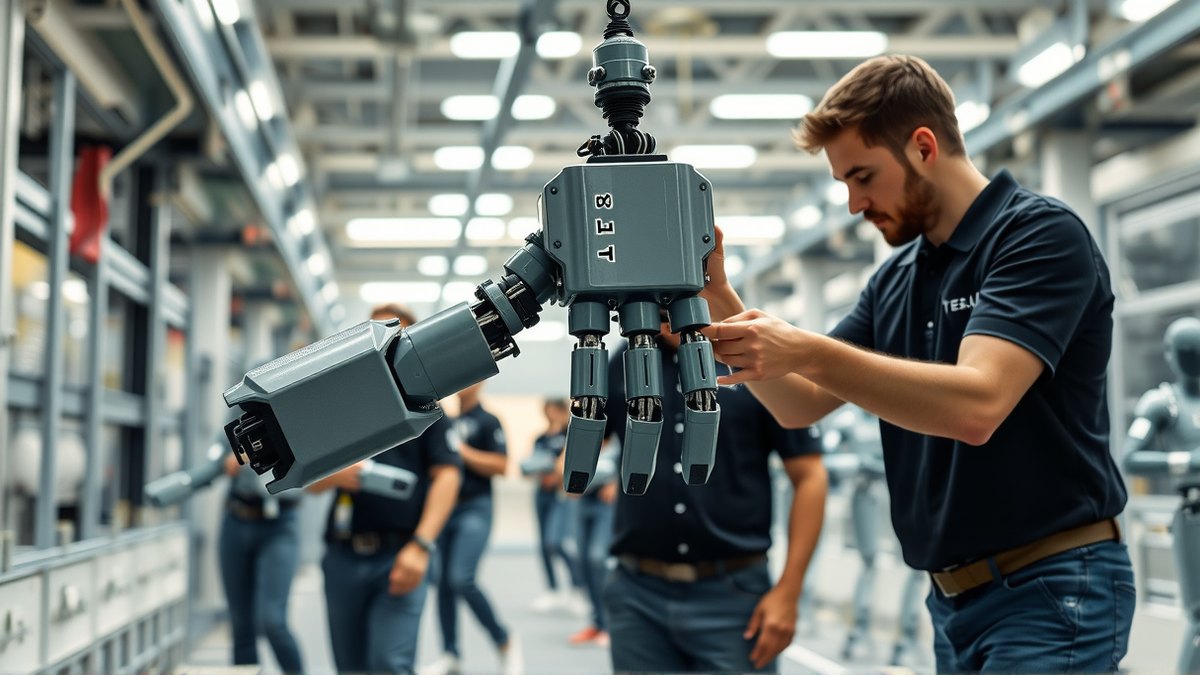
Tesla's push into humanoid robots is hitting real-world limits. According to The Information, reported by IT之家 and analyzed by Ars Technica, Optimus V3 production faces technical, industrial, and human hurdles. Output has already reached several hundred units a week, with a target of over 1,000 by late 2026.
A hundred parts in one hand
The artificial hand is a major bottleneck. Mimicking human dexterity requires more than a hundred small components in the hand and forearm, many of which are screws. Workers still assemble these parts manually, slowing production. Precision positioning equipment also struggles, capping speed as the line accelerates. Some new robots need manual repair immediately after leaving the line.
Tactile sensor reliability is another issue. Tesla developed a glove-like sensor layer that can be replaced independently if it fails, avoiding a full hand replacement.
AI still far from general-purpose
Optimus does not yet meet the bar for a true general-purpose robot. One source says it still requires programming for specific tasks and operates only in strictly controlled environments. This reflects a sector-wide problem: how to let a robot learn autonomously in the real world and perform varied human manipulations.
The human dimension is just as sensitive. Tesla asked some employees at its Texas and California plants to wear special suits that record body movements to collect training data during work. The practice caused discontent. Some felt they were helping train robots likely to take their jobs. The company then moved data collection to a dedicated team and set up a training center.
These difficulties are not unique to Tesla. The company also faces competition from other carmakers and robotics specialists. Its founder acknowledged that building an autonomous humanoid robot capable of diverse tasks is among the hardest problems to solve.
The open question is not whether a humanoid can walk, but whether it can learn on its own to perform varied gestures in an unprepared environment.
The business model remains unknown. Viability will depend on real, lasting, and profitable deployments, which are yet to be demonstrated.
Sources
2- 01IT之家 : 消息称特斯拉 Optimus V3 机器人量产遇阻ZH
- 02Ars Technica : Tesla workers balk at training Optimus humanoid robots as replacementsEN
All figures and quotations in this text come from the sources listed below.
Content prepared by the editorial team with AI assistance.
Grace Okonkwo
Comments
0- No comments yet — be the first.