China Puts 2030 Target on Solid-State Batteries, Tightens Grip on Tech Talent
China's Ministry of Industry and Information Technology released a five-year battery plan on Monday targeting initial large-scale use of all-solid-state batteries by 2030, according to CnEVPost. The move came the same week new exit rules and a reported Nvidia concession exposed competing impulses in Beijing's technology policy.
 Dr. Amara PatelEconomy, business and world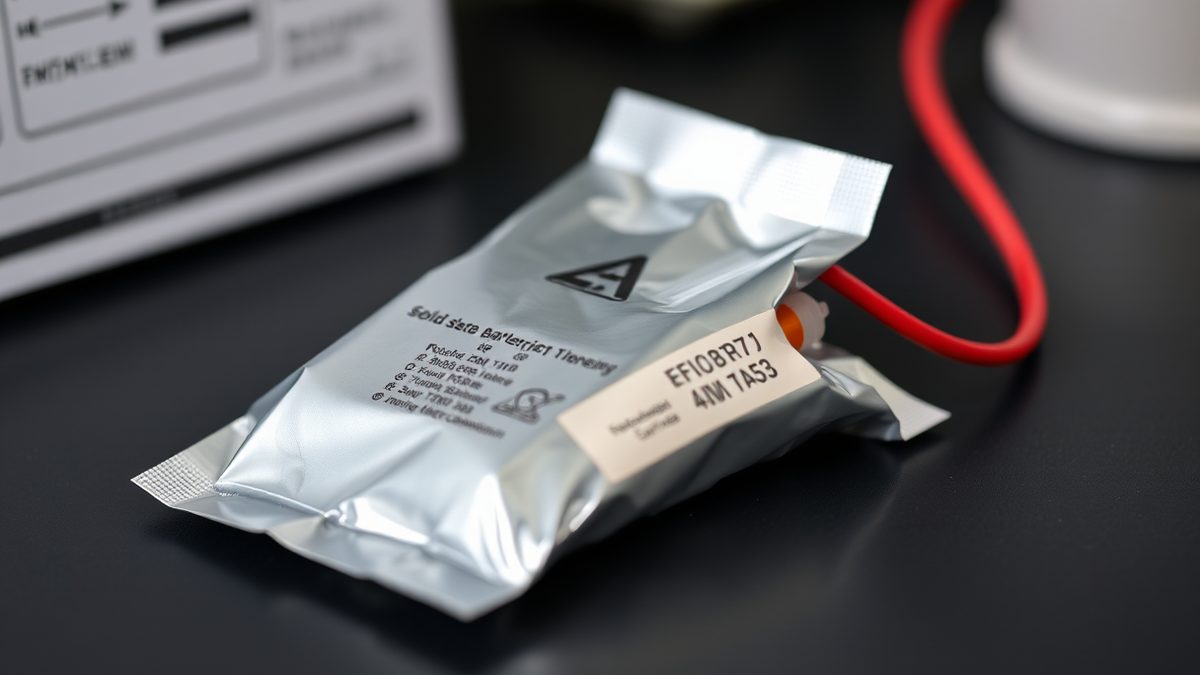
China aims to reach initial large-scale use of all-solid-state batteries by 2030. The target comes from a five-year battery industry development plan published on Monday by the Ministry of Industry and Information Technology. Dated 14 September, the document was jointly issued by seven government agencies, including the National Development and Reform Commission and the Ministry of Transport, CnEVPost reported.
The plan serves as a roadmap for 2026 through 2030 and sets several hard technical targets. Long-life lithium batteries should reach 15,000 charge-discharge cycles. Leading manufacturers should bring product defect rates down to the parts-per-billion level. All-solid-state chemistry sits at the centre of the document. It calls for faster breakthroughs in commercialisation technologies, with work focused on ionic conductivity and cycling stability while costs are optimised. Specific measures include improving interfacial contact, extending cycle life, advancing pressure-system engineering and scaling up production of high-performance solid electrolytes. The plan also wants high-voltage, high-capacity cathode materials combined with new lithium-metal anodes and anode-free designs. It names manufacturing equipment such as isostatic presses for solid-state production. China intends to build a supply system centred on lithium batteries, complemented by sodium and flow batteries, while strengthening its ability to commercialise all-solid-state and ultrafast-charging products.
Ambition meets a difficult manufacturing problem
That ambition runs into an engineering reality the industry has acknowledged for years. CATL's chairman said solid-state batteries must still clear three main hurdles before mass production, CnEVPost reported in June. The same outlet noted a Li Auto timeline pointing to limited vehicle use of solid-state cells only in 2027 or 2028. Scale is not a schedule problem that a government document can solve. It is a materials and process problem. The plan appears to reflect that, spending as much space on electrolytes, interfaces and press equipment as on the 2030 headline.
Two other threads in the document are likely to matter commercially. On sodium batteries, it emphasises cost, safety and resource availability. It calls for cold-resistant, high-energy-density power and storage cells with long cycle lives. On consolidation, it supports corporate mergers and restructuring, faster exploration of domestic lithium and cobalt resources, and collection systems for used batteries aligned with each company's sales volumes. Recycling capacity in major export markets is encouraged where conditions permit.
The plan also proposes a digital identity management system covering products such as new energy vehicle power batteries. It explores internationally accepted battery passport arrangements and promotes mutual recognition of carbon footprint data.
The battery plan follows China's 11 September release of a five-year plan for the intelligent connected NEV industry. That earlier automotive plan targets a 70% share for NEVs in domestic new passenger vehicle sales by 2030. According to CnEVPost, it called for tighter management of power battery production capacity. The new battery plan defines technology, manufacturing and application priorities in more detail.
Nvidia, travel rules and the export question
The battery document landed in a week when the export side of Chinese technology policy was moving in the opposite direction. The Information reported on Sunday that Beijing has signalled it may let firms such as Alibaba and ByteDance buy Nvidia's new RTX Pro 5500 chip. This is a workstation card built on the Blackwell design with 84GB of memory. The tech ministry recently asked some companies how many chips they plan to buy and for what purpose. It told some of them it intends to approve the purchases, according to the report, which TNW covered.
Reuters said it could not immediately verify that report. TNW said it had not independently verified it either. None of Nvidia, Alibaba, ByteDance or the ministry had commented publicly by Sunday.
The context matters. Nvidia's China sales have been limited both by US export controls and by Beijing's own curbs. These are meant to support domestic chipmakers. Earlier this year Washington cleared sales of Nvidia's H200 chips to Chinese firms. However, ByteDance and Tencent were told to keep the first shipments in Hong Kong rather than bring them into mainland China, TNW reported in August.
The travel file is tighter still. New entry-exit rules took effect in the week before 24 September. They give Chinese authorities the power to stop engineers, founders and other specialists from leaving the country if their expertise in batteries, rare earths or artificial intelligence is judged a threat to industrial and technological security, DW reported.
Henry Gao, a law professor at Singapore Management University, told DW the curbs "offer a rare glimpse into the true state of China's economy." He added that they suggest Beijing is deeply concerned about economic weakness and substantial capital outflows, and is determined to stop "entrepreneurs and skilled personnel from leaving the country."
DW cited Bloomberg Intelligence's estimate that some $1 trillion in Chinese wealth left the country last year. This was the largest outflow since records began in 2006. Alicia Garcia-Herrero, chief economist for Asia-Pacific at Natixis, told DW that the annual $50,000 foreign-exchange quota for households has not changed. However, unofficial routes around it are being squeezed. She argued the block on talent will matter more than the squeeze on capital: "You cannot easily replace a process engineer who cannot board a plane." Gao told DW the measures may prove counterproductive. They risk eroding confidence and accelerating the very capital flight they are meant to contain.
AI talks and the limits of a hotline
Export controls also hang over the AI file, where Washington and Beijing began talks this week. Before Donald Trump and Xi Jinping were due to meet on Thursday and Friday, Treasury Secretary Scott Bessent announced that both sides had discussed setting up an AI safety notification mechanism, Ars Technica reported. China has not publicly acknowledged the proposed alert system. People familiar with the plan told Politico it looks superficial. It involves no officials with technical expertise who could assess the urgency of risks described in communications. One source mocked it, telling Politico that "the scientific, technical term is BS."
Sam Bresnick, a research fellow at Georgetown's Center for Security and Emerging Technology, told Ars the absence of a technical body is a red flag. He said using an existing channel is better than creating a new one. "I think it's better than nothing for sure, but I don't have a lot of confidence that that is going to make a major difference going forward," he said. Su Lian Jye, chief analyst at the research group Omdia, told the South China Morning Post the alerts may promote transparency but will not make either side less wary. Turning the proposal into an effective tool would require agreed risk classifications, notification triggers, response protocols and regular reviews, he said. Ars noted that Trump's Justice Department accused six leading Chinese AI makers of stealing from US frontier labs two weeks ago. China has strongly disputed the claim. Congress is considering bills that would cut China off from more chips and hardware.
Writers Rumman Chowdhury and Konstantinos Komaitis argued in Rest of World on 22 September that Washington has framed the contest too narrowly around model performance. They pointed to Chinese rules on labelling AI-generated content. They also highlighted protections for children and the elderly against anthropomorphic AI manipulation, and bans on algorithmic price discrimination. They noted China's rules sit inside a system of extensive state control and censorship. The numbers they cite cut against the confidence of the race framing: 87% of Chinese citizens trust AI, compared with 23% in the US, they wrote. They also cited Airbnb CEO Brian Chesky saying his company uses Alibaba's Qwen model because it is good, fast and cheap. They noted that OpenAI's Sora deepfake episode cost the company a $1 billion licensing deal with Disney.
Elsewhere in health technology, physician and consultant Ruby Wang told Rest of World on 24 September that China now accounts for half of global drug licensing deals. Its share of global out-licensing deals could reach 60% this year. She cautioned that China is strongest in oncology and less mature in immunology. Chinese biotech firms remain weak at commercialisation, which is why so many sign deals with Western partners.
Read together, the week's documents describe a government trying to hold two positions at once. It is open enough to let its largest platforms buy foreign chips, but closed enough to keep its battery engineers and AI researchers from boarding a plane.
Sources
6- 01China unveils 5-year battery plan targeting large-scale all-solid-state use by 2030EN
- 02China reportedly may let Alibaba and ByteDance buy new Nvidia chipsEN
- 03China's new travel rules unsettle tech giants and talentEN
- 04Trump's China rivalry and "AI race" delusion may endanger US, experts sayEN
- 05America is in the wrong AI race with ChinaEN
- 06China is excelling in health tech. That's good news for the worldEN
All figures and quotations in this text come from the sources listed below.
Content prepared by the editorial team with AI assistance.
Dr. Amara Patel
Comments
0- No comments yet — be the first.