Superfluid Helium Qubit Design Targets 100x Lower Error; DOE Roadmap Sets 2028 Goal
University of Surrey researchers published a design for the first qubit built on superfluid helium, a charge-neutral device they calculate could cut error rates by about 100 times, according to a study in npj Quantum Information reported by ScienceDaily on 1 October. The same week, the US Department of Energy put a 2028 target on error-corrected machines.
 Rachel NwosuAI, models and technology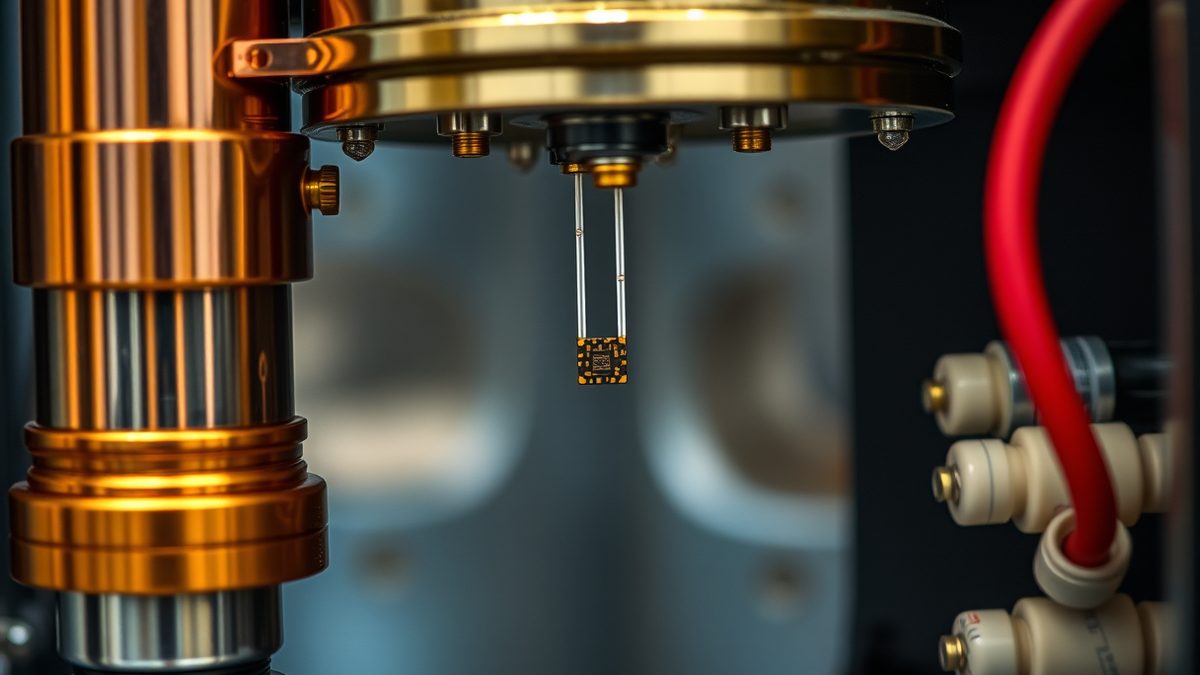
Surrey's Quantum Sciences Group proposed a device called the Superfluid Helium Oscillator Quantum (SHOQ). It uses superfluid helium-3, a liquid that flows without friction, as the qubit's core material. Because the helium carries no electric charge, the design should be less sensitive to the electromagnetic noise and stray charges that disturb today's superconducting circuits.
"The maths tells us that it should work," said Dr. Priya Sharma, a Daphne Jackson Fellow at Surrey and the study's lead author, in comments carried by ScienceDaily. "The next step is to make a prototype and put those predictions to the test."
The team says the SHOQ device is not meant to replace superconducting hardware. Instead, it could be integrated into the same systems, with different qubit types taking on different jobs. One longer-term option is quantum memory, where a superfluid qubit stores information while other hardware computes.
Policy moves faster than prototypes
Research timelines and policy timelines are now running in parallel. On 27 September, Fermilab published the US Department of Energy's SCAC Quantum Committee report. It calls for a milestone-driven path to a scientifically relevant, error-corrected quantum computer by 2028, and a long-term vision for a dedicated Quantum Computing User Facility. A subcommittee chaired by Fermilab chief technology officer Anna Grassellino led the report, with University of Chicago professor Supratik Guha as vice chair. Input came from national laboratories, academia, industry and federal agencies.
The document argues that success should be measured by scientific utility, not by qubit counts. "Our goal is not simply to build the largest quantum computer; it is to solve problems that are otherwise completely intractable," the DOE report says, listing drug discovery, catalysts, fusion-relevant materials and early-universe physics as targets.
Hardware results keep arriving in the meantime. On 25 September, ScienceDaily reported that researchers at the University of Chicago, Harvard, Stony Brook and Quantinuum demonstrated a universal gate set using non-Abelian anyons on 54 qubits of Quantinuum's H2 processor. The work, published in Nature, suggests fault-tolerant computation may be possible without the expensive magic state distillation that standard error correction requires. Quantinuum's Henrik Dreyer called non-Abelian codes "a dark horse in the race to quantum error correction."
Four days later, on 29 September, Kyoto University and Hiroshima University researchers reported an entangled measurement method for W states. This form of three-photon entanglement had resisted a one-shot measurement for more than 25 years. "More than 25 years after the initial proposal concerning the entangled measurement for GHZ states, we have finally obtained the entangled measurement for the W state as well," corresponding author Shigeki Takeuchi said, according to ScienceDaily.
Other recent results come from outside quantum computing proper. On 30 September, Caltech researchers published in Nature the first direct measurements of energy levels predicted by Ising and tricritical Ising conformal field theories, using laser-trapped atoms as a quantum simulator. The predicted ratios had gone unmeasured for about 40 years.
Commercial and industrial signals
Vendors are also moving. On 1 October, Q/C Technologies announced a collaboration with Sandia National Laboratories' Center for Integrated Nanotechnologies to develop nanophotonic components for its optical processing unit aimed at AI inference, according to HPCwire. The company said the project aims to establish a roadmap for optical AI hardware "beyond incremental GPU scaling."
The same day, EE Times published a webinar item from Arrow Electronics and Microchip on edge computing and embedded security for access control, including on-device facial recognition and liveness detection running on a 32-bit MPU with a single RGB camera. Separately, SpaceNews reported on 30 September that Quantum Space signed a launch processing work order with All Points Logistics for its Prime mission, targeting launch in the second half of 2027 at Vandenberg Space Force Base.
Two older items provide context. Google DeepMind's 23 September technical update described a persistent, encrypted server-side memory layer for its Private AI Compute platform, with keys held on user devices. Quanta Magazine reported on the same day that some researchers now argue biology's link to quantum mechanics is mathematical rather than physical, a claim attributed to Princeton chemist Gregory Scholes.
The DOE roadmap sets a 2028 date. Surrey's qubit is still a calculation. Between those two points sits the question the field has not answered: which error-correction path actually scales.
Sources
12- 01This new qubit could be 100 times less error-prone in superfluid quantum computer breakthroughEN
- 02Quantum computing's "dark horse" just proved it can go universalEN
- 03Quantum teleportation breakthrough: Scientists crack a 25-year entanglement challengeEN
- 04Caltech physicists finally measure a quantum energy ladder predicted 40 years agoEN
- 05DOE releases national quantum computing roadmap following field-wide effort led by SCAC subcommitteeEN
- 06Q/C Technologies Collaborates with Sandia on Optical Computing for AI InferenceEN
- 07Edge Computing and Security for Access Control Applications: Getting the Best of the Two WorldsEN
- 08Quantum Space Executes Launch Processing Agreement with All Points Logistics for Prime MissionEN
- 09Advancing Private AI Compute with secure, server-side memoryEN
- 10Biology Might Not Be Quantum, but Its Math Is QuantumlikeEN
- 11Quantum computer simulates matter "popping into existence"EN
- 12AI-Defined Vehicles Push Compute, Memory, And Validation LimitsEN
All figures and quotations in this text come from the sources listed below.
Content prepared by the editorial team with AI assistance.
Rachel Nwosu
Comments
0- No comments yet — be the first.