Quantum Supremacy: How Google, IBM and Rivals Chased the Qubit Milestone
Google's plan to reach "quantum supremacy" by the end of 2017 slipped, but by September 2019 the company claimed its 53-qubit Sycamore processor had done in 200 seconds what a top supercomputer would need 10,000 years to match.
 Grace OkonkwoAI, models and technology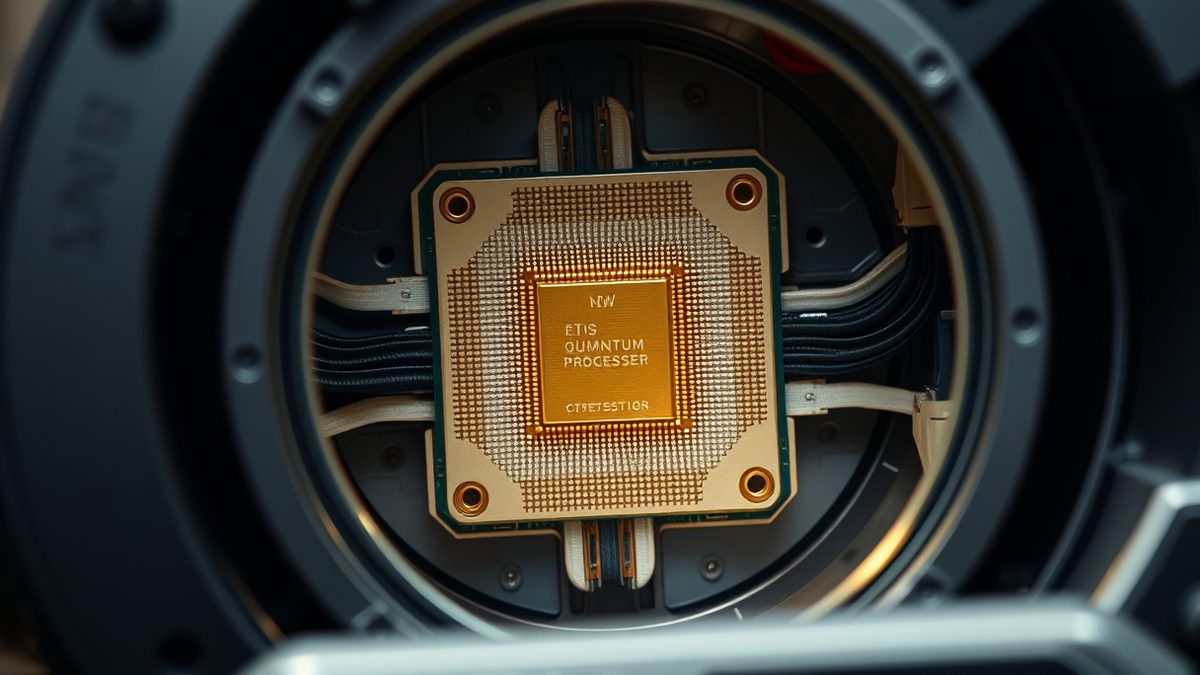
John Martinis, leader of Google's quantum research group, told MIT Technology Review in April 2017 that his team of roughly 25 would build a device capable of "quantum supremacy" by the end of that year. The target was a grid of 49 qubits. The hardware he had to show at the time had six.
That gap between promise and silicon is a useful lens on the quantum computing milestone race. By the end of the decade it had become a contest over vocabulary as much as physics. Google, IBM, Intel, Microsoft and a cluster of startups each pushed their own metric for progress. The numbers moved. The definitions did not settle.
A six-qubit stepping stone
Google's six-qubit chip, described by Martinis at the IEEE TechIgnite conference in Burlingame, California, arranged its qubits in a two-by-three configuration. The point was not raw count. It was to show the technology still worked when qubits sat side by side, as they would need to in larger devices. The chip also tested a manufacturing method in which qubits and the conventional wiring controlling them are made on separate chips and later "bump bonded" together. Google's team had focused on that approach since it was established just over two years earlier, aiming to eliminate the extra control lines that can interfere with qubit function.
"That process is all working," Martinis told MIT Technology Review. "Now we're ready to kind of move fast."
Martinis joined Google in late 2014 from the University of California, Santa Barbara, where he remained a professor. MIT's Simon Gustavsson, a principal investigator in a quantum computing research group, described the field's leadership as "pretty comparable between Google and IBM." Chris Monroe, a University of Maryland professor and cofounder of the startup IonQ, was blunt about what a supremacy demonstration would mean: "It'll be an academic milestone. Afterward you still have to figure out how to make it more scalable and programmable."
Martinis agreed much remained. He argued the experiment could become a benchmark for anyone claiming a working quantum computer, and said the target helped Google managers and cofounder Sergey Brin appreciate that the technology was becoming real. "They all get it and are very excited about it," he said.
IBM answers with 50 qubits
IBM went first on the headline number. On Friday 10 November 2017, Dario Gil, who led IBM's quantum computing and artificial intelligence research division, said the company's scientists had successfully built and measured a processor prototype with 50 qubits. Gil called it the first time any company had built a quantum computer at that scale, according to the Associated Press report carried by The Seattle Times.
Seth Lloyd, an MIT mechanical engineering professor not involved in IBM's research, said it was likely IBM still had glitches to work out but that the announcement was a sign of significant progress. The article offered no independent verification of the performance claim.
A month later, at the first quantum computing for business conference at NASA Ames, Martinis pushed back on qubit counting as a scoreboard. "Press releases always talk about quantum space race in number of qubits," he said, according to Gizmodo. "It's more than just quantity, it's qubit quality."
Gizmodo reported on 8 December 2017 that Google was then fabricating its 49 or 50 qubit supremacy device, with testing to begin in two weeks, not counting Christmas vacation delays. The piece also sketched what the test would involve: entangling qubits, letting the system evolve, and sampling outcomes whose probability distribution is so complex that a classical machine must simulate the quantum computer to check it, potentially taking weeks to do what the quantum device does in minutes. Caltech theorist John Preskill, who attended, described the moment as the NISQ era, for Noisy, Intermediate-Scale quantum computer.
Supremacy claimed, then contested
The claim arrived in September 2019. Fortune obtained a copy of a Google paper that had been posted to NASA.gov earlier in the week before being taken down. A Google spokesperson declined to confirm the paper's authenticity and results. A source at Google familiar with the situation suggested NASA had accidentally published it early, before peer review that could take weeks to months. The Financial Times first reported the news.
The paper's central numbers were stark. "While our processor takes about 200 seconds to sample one instance of the quantum circuit 1 million times, a state-of-the-art supercomputer would require approximately 10,000 years to perform the equivalent task," the researchers wrote. The chip, named Sycamore, contained 53 qubits. The team had scaled back from a 72-qubit design called Bristlecone. On a Google Cloud server, the researchers estimated, the same experiment would take 50 trillion hours; on the quantum processor, 30 seconds. They wrote that quantum speedup was "achievable in a real-world system and is not precluded by any hidden physical laws," and predicted quantum computing power would grow at a double exponential rate, faster than Moore's Law.
Not everyone accepted the framing. Dario Gil, head of IBM Research, told Fortune the experiment was a highly special case laboratory demonstration with "no practical applications," and advised against using quantum supremacy as a progress metric. "The experiment and the 'supremacy' term will be misunderstood by nearly all," he said. "Quantum computers will never reign 'supreme' over classical computers, but will rather work in concert with them, since each have their unique strengths." Jim Clarke, Intel Labs' director of quantum hardware, called it "a notable mile marker" and said a commercially viable quantum computer would require many more R&D advances. "While development is still at mile one of this marathon, we strongly believe in the potential of this technology," he said.
The metric problem
IBM had already begun arguing for a different yardstick. In March 2019, ZDNET reported, IBM outlined its highest Quantum Volume to date at the American Physical Society March Meeting. Quantum Volume is determined by qubit count, connectivity and coherence time, plus gate and measurement errors, device cross talk and circuit software compiler efficiency. IBM said its Q System One, with a 20-qubit processor, produced a Quantum Volume of 16, double the then-current IBM Q at 8, and had some of the lowest error rates IBM had measured. IBM said Quantum Volume would need to double every year to reach Quantum Advantage, the point where quantum applications deliver significant advantages over classical computers, within the next decade. It had doubled the power of its quantum computers annually since 2017.
That is the recurring shape of this race. A company sets a target, misses the date, then redefines the finish line. Martinis promised supremacy by the end of 2017 with 49 qubits. Google delivered a claim in 2019 with 53. IBM answered with a 50-qubit prototype and then with a composite metric that made qubit count only one input among several. The hardware is real. The scoreboard is not.
Sources
5- 01Google's New Chip Is a Stepping Stone to Quantum Computing SupremacyEN
- 02IBM says it's reached milestone in quantum computingEN
- 03Why Google Is Poised to Hit the Next Critical Milestone in Quantum ComputingEN
- 04IBM hits quantum computing milestone, may see 'Quantum Advantage' in 2020sEN
- 05Google Claims 'Quantum Supremacy,' Marking a Major Milestone in ComputingEN
All figures and quotations in this text come from the sources listed below.
Content prepared by the editorial team with AI assistance.
Grace Okonkwo
Comments
0- No comments yet — be the first.