Nvidia eyes 70 percent growth as one system costs $8.5 million
Jensen Huang projects 70 percent revenue growth next year. He says "one GPU" is no longer a $399 card. It is an $8.5 million system built from 2 million parts.
 Dr. Amara PatelEconomy, business and world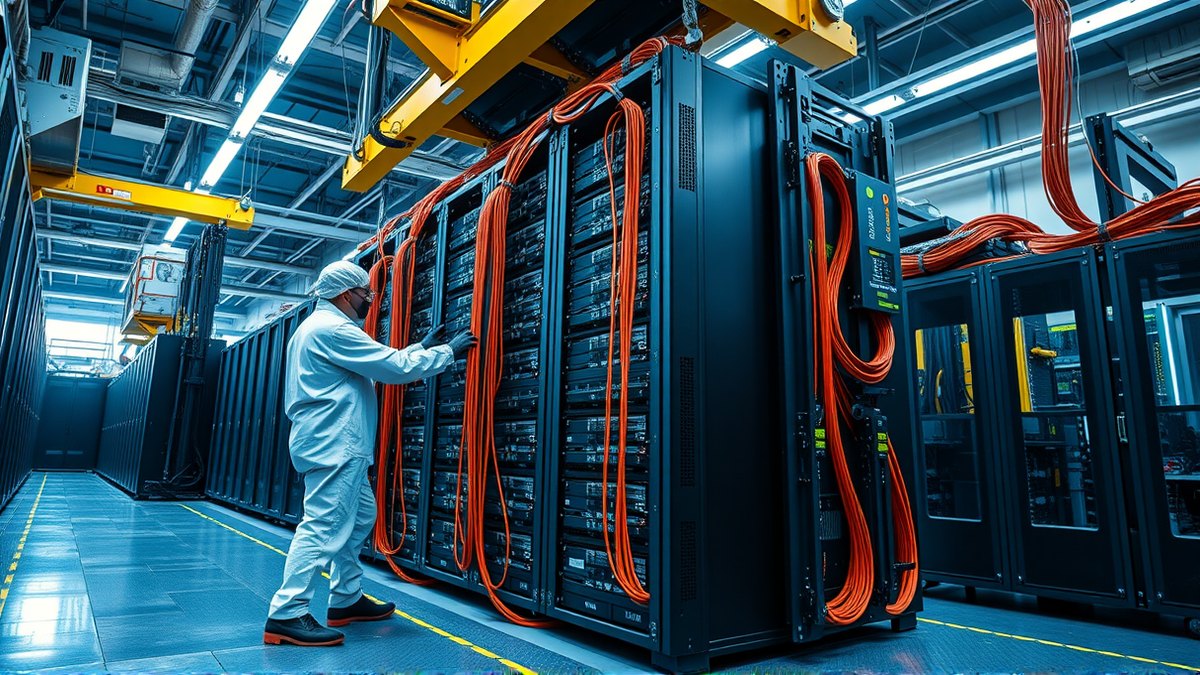
Jensen Huang spoke at the Goldman Sachs Communacopia and Technology conference to explain why Nvidia is not slowing down. "Most people think Nvidia builds a chip. You need airplanes to carry what we build," the chief executive said, according to TechCrunch.
His sharpest point concerned price. "One GPU today is not $399. It is $8.5 million. One GPU, everything connected by NVLink, 2 million parts, 250,000 kilowatts," Huang said. Orders for one specific system, where 36 Grace processors link with 72 Blackwell chips, are growing 27 percent month over month.
This is not just marketing. Second-quarter results, released alongside an expanded deal with Amazon, showed $96.2 billion in revenue. Data centers accounted for $89 billion, up 117 percent year over year. The company forecast $108 billion in revenue for the third quarter, partly driven by new-generation Rubin chips.
Demand is visible in order sizes. Amazon doubled its bet. After ordering more than a million Nvidia chips for 2026, it is adding 2 million GPUs for AWS data centers in 2027 and 2028, including Blackwell Ultra, Rubin and Rubin Ultra. The company is also developing its own chips. Its latest quarterly report stated that its in-house chip business exceeded $25 billion in annualized revenue, supported by $225 billion in commitments from AI labs like Anthropic and OpenAI.
Huang names the competition directly: hyperscalers like Amazon, Microsoft and Google building their own chips; AI labs doing the same; listed firm Cerebras; and startups such as Etched. His answer focuses on system scale rather than individual chips. That is the core of this year's AI money narrative. Customers are not buying silicon. They are buying complete, ready-to-work installations drawing hundreds of kilowatts.
Nvidia's response to competition is financial, not technical. Hyperscaler in-house systems and startup specialized chips handle individual inference tasks. They do not replace entire training installations. If a customer buys a ready system drawing hundreds of kilowatts instead of a card, the growing number of units ordered translates into revenue at a pace no inference chip maker can match. The 70 percent growth forecast is not a boast in this context. It is a consequence of the price list: the larger the installation, the larger the bill, and bills are now paid in billions of dollars.
Sources
2- 01Jensen Huang explains why Nvidia will grow 70% next yearEN
- 02Amazon just tripled its order of Nvidia chipsEN
All figures and quotations in this text come from the sources listed below.
Content prepared by the editorial team with AI assistance.
Dr. Amara Patel
Comments
0- No comments yet — be the first.