Niagara 1895: the first large AC power plant and the 32-kilometre line to Buffalo
Westinghouse generators, built on Tesla's patents, started up on 25 August 1895. The tailrace tunnel cost 28 workers their lives, and the war over current ended in a merger that created General Electric.
 Helen MarshCulture, food and lifestyle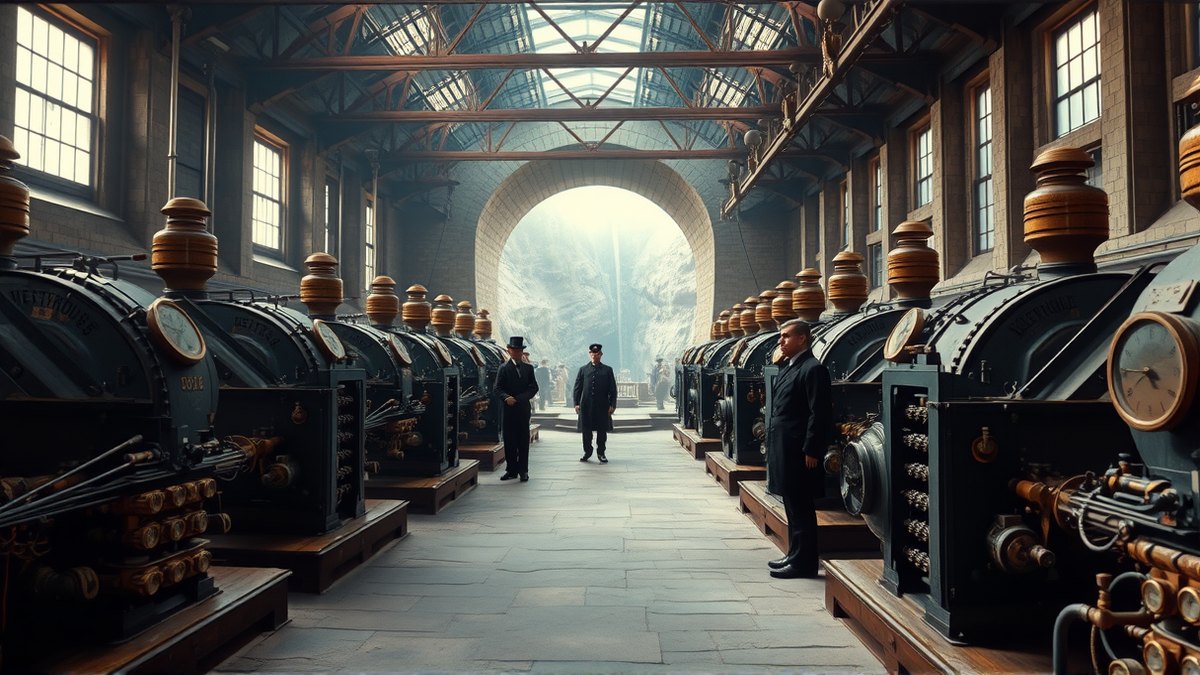
The plan to harness the waterfall took shape in 1886. Engineer Thomas Evershed proposed a hydraulic canal and a brick-lined tunnel 7,500 feet (2,300 metres) long. The Niagara Falls Power Company was founded at the same time. A new firm, the Cataract Construction Company, led by Edward Dean Adams, established the International Niagara Commission in 1890. The commission favoured electricity but could not specify a solution. In 1892, the company hired George Forbes as technical consultant. By May 1893, he had persuaded them to build a system based on three-phase alternating current.
Westinghouse Electric took the subcontract. It supplied generators of 5,000 horsepower (3.7 megawatts) at 25 Hz, based on the work of Nikola Tesla and Benjamin G. Lamme. The I. P. Morris company of Philadelphia built the turbines to a design by the Swiss firm Faesch and Piccard. The power plant went into service on 25 August 1895. The transformer house, built from locally quarried limestone, was designed by McKim, Mead and White.
Tunnel, bricks and the toll of lives
Water from the generators drained through a tunnel 7,000 feet long, with a cross-section of 18 by 21 feet. Construction took more than three years and used over 16,000,000 bricks in a four-layer lining. It cost 28 workers their lives. Niagara Power Station No. 1 eventually reached 50,000 horsepower (37 megawatts). Ten generators of 5,000 horsepower each operated there, featuring a rotating outer field and a vertical shaft. They were split into two banks of five, each with independent switchboards. Current left at 2,000 volts. Transformers raised it to 10,000 volts for the area around the falls and to 20,000 volts for distant Buffalo, Lockport and Tonawanda. The plant became the model for a second, similar station built in 1904. The original Westinghouse generators ran until the plant closed in 1961. The complex was named after Adams in 1927.
The war over current
The process was not without conflict. In 1886, Westinghouse introduced the alternating-current system with transformers. By early 1888, the Edison Electric Light Company began publicly claiming that high voltages were dangerous and that the solution infringed its patents. In spring 1888, a press storm erupted over fatal accidents on overhead high-voltage lines. That same year, Westinghouse engineer Oliver B. Shallenberger developed an induction meter using a rotating magnetic field, giving the company a way to bill for electricity consumption. In July 1888, Westinghouse paid a substantial sum for a licence to Tesla's American patents on the three-phase induction motor. In 1892, the merger of Edison Electric with Thomson-Houston created General Electric, ending the "war of the currents". A year later, Westinghouse won the tender to power the World's Columbian Exposition in Chicago. It then secured most of the contract for the Niagara power plant, sharing it partly with General Electric.
Sources
2All figures and quotations in this text come from the sources listed below.
Content prepared by the editorial team with AI assistance.
Helen Marsh
Comments
0- No comments yet — be the first.