Humanoid robots move onto the factory floor, but the hands are still the hard part
A Wuhan court ruled on 28 September that AI production costs count as a factor in copyright damages, a first for China's courts, according to The Decoder. The same week, the International Federation of Robotics put the global industrial robot fleet at a record 5 million units, with humanoid makers still struggling to mass-produce working hands.
 Rachel NwosuAI, models and technology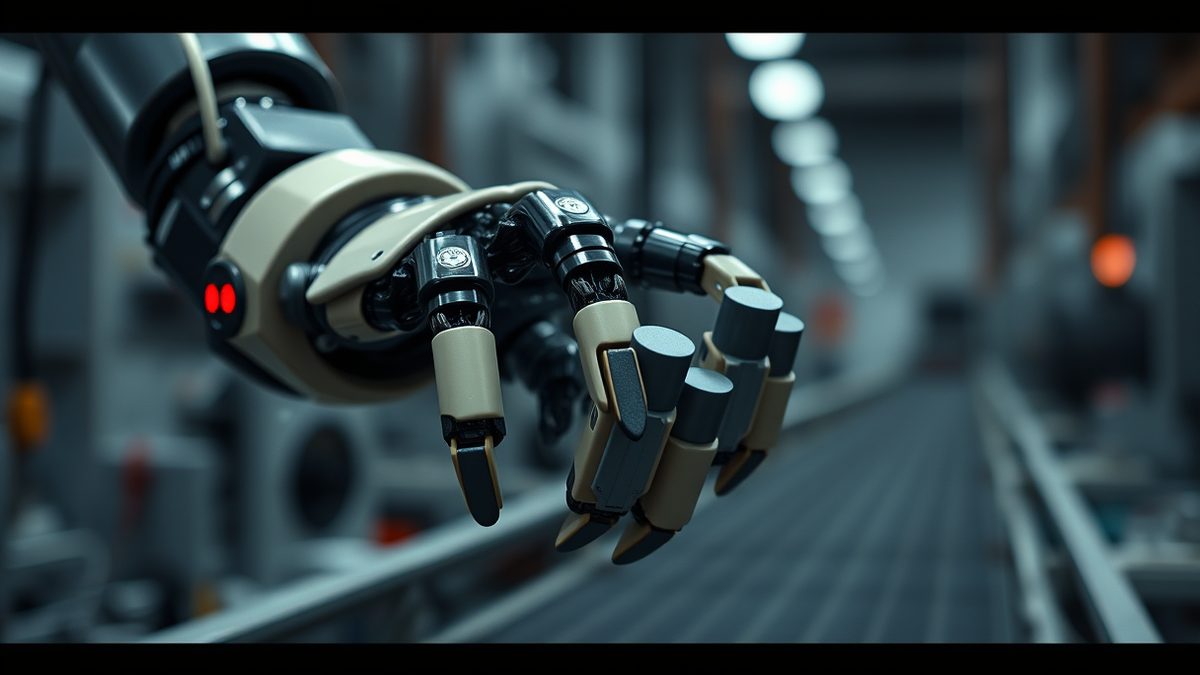
The newest humanoid robot story on 28 September is not about a factory at all. It is about a courtroom in Wuhan.
A court there included AI tool licensing fees and token usage in a copyright damages calculation for the first time, The Decoder reported on 28 September, citing the National Law Review. The case involved a one-hour AI-generated short drama, copied the day after publication and republished under a new title with ads. The court awarded the plaintiff 20,000 RMB, about $2,900. It classified the drama as a protectable audiovisual work because employees made creative decisions at every stage, from script to prompt design to final edit. The AI was a tool, the court said. That framing matters for anyone building robots with language models inside them: the humans still own the decisions.
Industrial robots, meanwhile, have already crossed a threshold that humanoids have not. The International Federation of Robotics said on 27 September that the global operational stock of industrial robots rose 9% to a record 5 million units in 2025, driven by an 11% jump in installations. Factories installed more than 600,000 new units last year.
"Industrial automation is progressing at high speed," said Jane Heffner, president of the IFR. "The new mark of 5 million robots operational in factories worldwide is more than double the number seven years ago."
That number is about the installed base of conventional industrial arms, not humanoids. China accounts for 59% of global deployments, with 354,000 units installed in 2025, up 20% year on year. The United States passed Japan to become the second-largest market, with almost 38,500 units installed, up 12%. Japan fell 19% to 36,219 units. Germany held fifth place globally but saw sales drop 8% to fewer than 25,000 units.
The gap between orders and revenue
Humanoid makers are trying to move from demonstrations to volume. Agility Robotics, which makes the Digit humanoid, is going public through a SPAC with Churchill Capital Corp. XI at a $2.5 billion valuation, The Robot Report noted on 25 September. The deal is expected to generate more than $620 million in gross proceeds. The same filing showed the scale problem. Agility reported $1.8 million in 2025 revenue against a $140 million operating loss. It said it has more than $300 million in multi-year Digit v5 orders from a single customer, to be fulfilled over the coming years. That is a large backlog and a small revenue line at the same time.
Agility CEO Jonathan Hurst told The Robot Report the company is exploring wheeled robots, after a wheeled humanoid appeared briefly in the Digit 5 launch video. "We're exploring a range of robot designs and form factors, including wheels, to address different operating environments and customer needs," Hurst said via email. Asked whether that means a wheeled Digit or a new robot, he said: "Too early to say!"
The legs-versus-wheels question is old, but the commercial pressure is new. Wheels are simpler and cheaper on flat floors. Legs handle stairs and human-shaped spaces. For a company with a $140 million operating loss and a SPAC to close, the cheaper form factor is worth at least a slide in a launch video.
Tesla's hand problem
Tesla has the opposite problem: it is trying to build the hardest version of the robot first. Ars Technica reported on 26 September, citing extensive reporting by The Information, that Tesla has scaled Optimus production to hundreds of robots per week while targeting more than 1,000 per week by the end of 2026. The Fremont factory stopped making the Model S and Model X as of May 2026, with line workers and engineers moved onto Optimus. The bottleneck is partly manual. Workers assemble Optimus hands and forearms by hand, and the two parts together contain more than 100 small components such as screws, according to The Information. Newly produced robots arrive needing immediate fixes. Touch sensors have been unreliable enough that Tesla developed a glove-like sensor layer that can be replaced without swapping the whole hand.
Training data is the other constraint. Tesla had factory workers in Texas and California wear suits that record their physical movements, but The Information described some workers complaining because they "knew the robots were designed to eventually replace them." Tesla has since moved data collection to dedicated teams and set up training hubs. The company still relies on Chinese suppliers for various robot components, The Information reported. In July, the Federal Communications Commission banned new foreign-made robots including humanoids and four-legged robot dogs, along with robot vacuum cleaners, as part of a push to boost domestic supply chains.
Musk has described Optimus as potentially "the biggest product ever" on Tesla's second-quarter 2026 earnings call, while acknowledging that a general-purpose autonomous humanoid is "one of the hardest things to solve." One of The Information's sources described the current robots as requiring programming for specific tasks in carefully controlled environments.
Toyota counts workers before robots
Toyota is approaching the same problem with a number attached. Ars Technica reported on 23 September, citing Nikkei Asia, that the Toyota Motor group plans to start investing $6.42 billion every year from 2028 into factory upgrades, targeting 150,000 robots in its own plants and another 250,000 at group facilities. Toyota has already put some of its ELEY humanoid robots on assembly lines, where workers teach them precise hand movements by wearing jigs based on the robots' fingers.
Executive vice president Hiroki Nakajima told Nikkei Asia the company aims for "a world where robots coexist with humans, rather than replacing them." Toyota has 18,000 veteran workers across 60 factories worldwide, including 11 US manufacturing plants. It is unclear how many robots Toyota has deployed so far or how many of the planned units will be humanoids.
Hyundai is taking a similar route through its US subsidiary Boston Dynamics. Ars Technica reported that Hyundai plans to deploy up to 25,000 Atlas humanoid robots over the next several years, starting in 2028, and that Boston Dynamics opened a training center at Hyundai Motor Group Metaplant America in Georgia on 21 September.
Smaller bets and a language model in the kitchen
Below the automakers, smaller companies are betting that modularity beats scale. O-ID, a Tokyo-based startup founded in 2025 by Norwegian CEO Stian Jakobsen and Dutch CTO Simon Gormuzov, raised $1.2 million in pre-seed funding led by Chicago-based TAWANI Ventures, with Hustle Fund, Techstars and angel investors participating, Tech.eu reported on 24 September. The company is building a modular humanoid for manufacturing and logistics, with factory pilots planned for 2027.
Jakobsen told Tech.eu that Japan has some catching up to do in commercialising humanoids but that its manufacturing base could be an advantage. The pitch is repairability: a single failed component should not take a whole robot out of service for months. By contrast, General Robotics is working on modular intelligence rather than modular hardware, with CTO Sai Vemprala describing the company's GRID architecture on The Robot Report Podcast on 25 September.
On the software side, researchers at Stanford and Caltech built HomeBody, a system that lets a Unitree G1 robot tidy an unfamiliar kitchen using GPT-6 Astra as the vision-language model, The Decoder reported on 27 September. The system skips the usual trained control layer, has the robot build a digital twin in Nvidia's Isaac Sim, and lets the model call directly into a skill library for grasping, navigating and opening drawers. Reported limitations include Astra's latency, overheating finger servos and high compute costs.
The safety debate is running alongside the engineering. The Robot Report published a piece on 27 September arguing that Asimov's Three Laws are insufficient, noting that Dario Amodei, CEO of Anthropic, called for slowing frontier AI development in a 12 September post titled "We Must Pace the Frontier." Sam Altman and Elon Musk agreed with Amodei, according to the piece, while Nvidia CEO Jensen Huang called concerns about AI dangers overblown.
Put the numbers side by side and the picture is not complicated. Industrial robots are a 5-million-unit installed base with a 9% growth forecast to 655,000 new units in 2026. Humanoids are a few hundred units a week at Tesla, a $1.8 million revenue line at Agility, and a $1.2 million seed round at O-ID. The factories are already full of robots. The humanoids are still trying to prove their hands work.
Sources
10- 01A Wuhan court just made AI production costs a legal factor in copyright infringement casesEN
- 02Five Million Robots now Operate in Factories GloballyEN
- 035 million robots are now at work in factories worldwide, reports the IFREN
- 04Agility Robotics, maker of Digit humanoid, exploring wheeled robotsEN
- 05Tesla workers balk at training Optimus humanoid robots as replacementsEN
- 06Toyota orders workers to train humanoid robots but says humans won't be replacedEN
- 07Europeans in Japan raise $1.2M to put modular humanoid robots to workEN
- 08Researchers plug GPT-6 Astra directly into a robot and let it clean up an unfamiliar kitchenEN
- 09Asimov's laws are not enough to keep robotics and AI safeEN
- 10General Robotics is betting on modular intelligence, not one robot brainEN
All figures and quotations in this text come from the sources listed below.
Content prepared by the editorial team with AI assistance.
Rachel Nwosu
Comments
0- No comments yet — be the first.