Robot makers chase human speed as Innodata opens motion-capture lab
Innodata opened a motion-capture laboratory on 30 September to generate training data for humanoid and industrial robots, claiming direct 3D capture beats inferring motion from 2D video. The same day, MindOn said its Mind-1 model cut robot inference latency from 82ms to 32ms.
 Grace OkonkwoAI, models and technology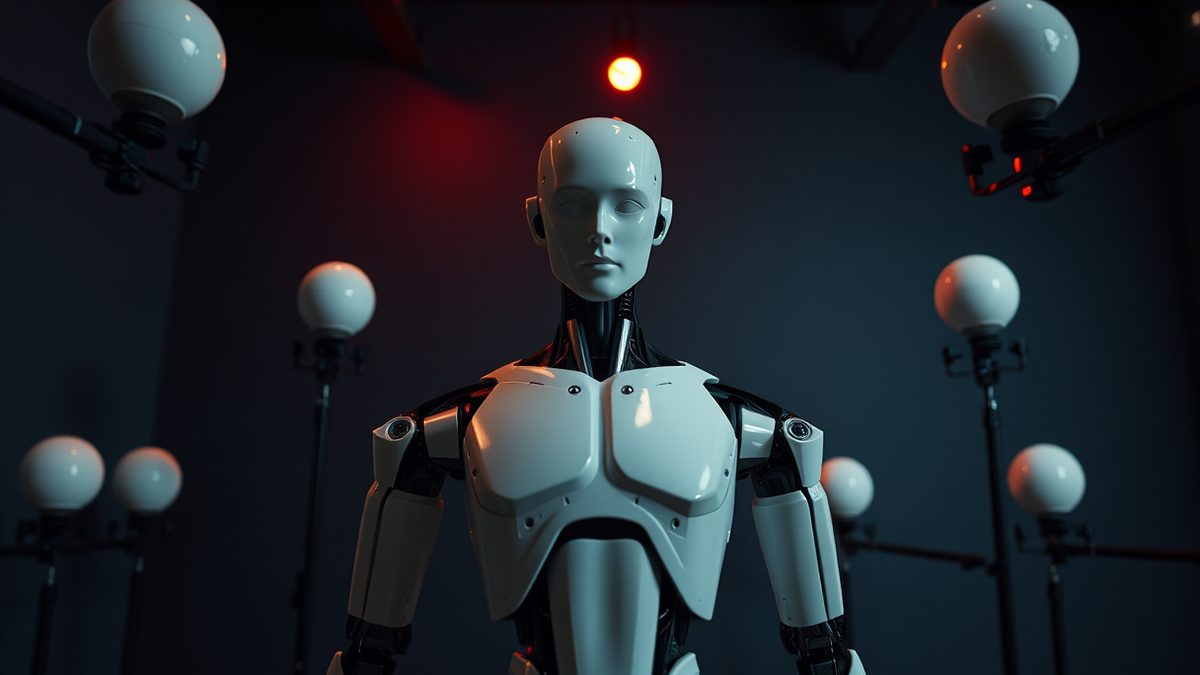
Innodata opened a motion-capture laboratory on 30 September. The company said it will generate training data for humanoid and industrial robots and independently validate the performance data robots produce internally. Founded in 1988 in Ridgefield Park, New Jersey, Innodata captures 3D data directly from bodies, whether human or mechanical, rather than inferring motion by analysing 2D video.
According to The Robot Report, the facility targets teams that hit what Innodata calls a data wall.
"There is just no substitute for direct 3D motion capture," Franklin Tanner, Innodata's vice president of robotics and physical AI, told The Robot Report. He explained that sensors are designed to register the tiniest motion of every joint. When training a humanoid weighing almost 200 lb (90.7 kg), readings "cannot be in the ballpark." Tanner gave the example of a robot picking up a mug. Grabbing the handle is normal. Grabbing the base is not wrong unless the mug holds hot liquid. Context, he said, is not always encoded in existing data sets.
The data problem is not only about volume. Tanner described physical AI as having to "earn its tokens one interaction at a time." Innodata produces training data across humanoids, teleoperated hardware, wearable systems, sensor rigs, Universal Manipulator Interface grippers and other multimodal capture setups. The data can feed digital twins for edge cases. The lab also performs independent validation, which matters as vendors publish performance claims that buyers cannot easily check.
Speed becomes the next battleground
The same day, MindOn introduced Mind-1, a physical AI model it says brings robot task execution to human-level speed across logistics and everyday environments. Some tasks are completed faster than humans. The company published latency figures: inference reduced from 82ms to 32ms. Its engineering argument is concrete. At an end-effector speed of 3 m/s, 10ms of latency equals roughly 3cm of movement. That is enough to affect precise grasping, insertion or contact-rich manipulation.
MindOn also points at the training data itself. Much robot manipulation data comes from teleoperation, which is often slower than natural human motion. Models learn the tempo of their demonstrations along with the task. A robot that completes a task five or ten times slower than a person remains hard to put into real workflows, the company argues. That is a shift in emphasis from whether a robot can do a task to whether it can do it at the cycle time a warehouse or factory needs.
Those commercial claims will be tested against independent measurement. Fig Inc. published an evaluation on 30 September across five domains, including Bench2Drive, VLABench, IndEgo and Assembly101. It found what it calls jagged performance: in every model pair tested, the lower-scoring model solved tasks the higher-scoring one failed. The best model changed with the website and with the benchmark's own difficulty labels. A model update could leave the average almost unchanged while many individual tasks flipped. Fig released item-level results under the name RIDGE.
That matters for anyone buying a robot on a benchmark number. A headline average hides how much success varies across tasks, the authors argue. The task category a model is deployed on affects reliability about as much as the choice of model. For factory deployments, the failure that counts is the one on your line, not the one averaged away.
Startups sell the layer, not the body
Destro came out of stealth on 30 September with an $8 million seed round and an unusual pitch: it is not a robotics company. TechCrunch reported that the startup built an AI layer that also directs human workers. It is running a pilot at a Yusen Logistics facility in the Pacific Northwest with three cart-moving robots built by Miva Robotics. The robots are operated by Destro's Vision system, based on open-weight vision-language-action models. Richard Brunelle, director of automation for Yusen's American logistics group, told TechCrunch he asked Destro to adapt its picking and packing tool for cross-docking, where goods move from one truck into mixed loads for others.
"A lot of robotics companies started from robotics engineers asking, what cool things I can do?" Destro founder Manthan Pawar told TechCrunch. "One of the biggest reasons we are winning against robotics companies is because we are not a robotics company."
Inbolt, a Paris industrial robotics company founded in 2019, raised €11 million on 30 September to expand internationally and enter data centre and electronics manufacturing, according to Tech.eu. The round was led by Shift4Good with Bridges Climate Transition Partners and existing investors BNP Paribas Développement and Ora Global, bringing total funding to €30 million. Inbolt combines 3D vision with a hardware-agnostic AI software layer that adjusts robot control loops in real time. The company says its system runs on more than 200 robots in over 100 factories across three continents, with customers including Bosch, Beko, Flex, Ford, Stellantis and Toyota.
Both companies are selling the same insight: the hardware is increasingly a commodity. The difficult part is making an installed base cope with variation, misaligned parts and tooling wear without stopping the line.
The industrial base is still the point
The clearest counterweight to humanoid hype sits in the older installed base. Linton Crystal Technologies sued Zhejiang Jingsheng in the US District Court for the Eastern District of Texas, Marshall Division, on 22 September. It asserted two patents covering a seed lifting and rotating system for Czochralski crystal pullers, according to Electrek. Jingsheng, which trades in Shenzhen and is valued at about 53 billion yuan, disclosed the suit to investors on 24 September. The company said its products use "technical solutions entirely different" from the patents, that it has not been formally served and that it expects no material impact. Linton is asking for damages, treble damages for willful infringement and a permanent injunction.
The case touches Tesla's planned solar factory in Texas because pullers are the first step in making wafers. Chinese trade press has reported that Jingsheng won a roughly 3 billion yuan (about $420 million) Tesla order for crystal pullers earlier this year. It laid out a timeline in which a Tesla tender closed in February, contracts were signed in March, shipments started in April and full delivery was planned for the third quarter. Neither Tesla nor Jingsheng has confirmed the order, and Tesla is not a party to the lawsuit. Electrek also noted that Jingsheng's revenue fell about 40% year over year in the first half of 2026. Dalian Linton posted a small loss over the same period, as a Chinese solar manufacturing glut crushed equipment orders.
A different kind of reality check came from KIDZ AI, a Nasdaq-listed company worth about $2.4 million. It announced on 30 September that it had sent Tesla a procurement inquiry for 500 Robotaxis. Electrek reported that the company, formerly an online coding school called Classover Holdings, said the inquiry does not constitute a binding order and that the plan is in a preliminary phase. Its Q2 2026 results showed service revenue down 34% year over year to $0.48 million and a $2.5 million quarterly loss. The stock rose about 10% in pre-market trading and fell about 6% after the open. It is down about 99.97% over the past year.
Elsewhere in the same 30 September pile, The Robot Report's parent Arrowfly launched AI for Engineers. The platform includes a news desk, an annual conference scheduled for 20 to 22 September 2027 in Henderson, Nevada, original research and an advisory board. It targets engineers applying AI in product design, manufacturing, robotics, medtech and energy. The pitch is about moving from experimentation to repeatable applications rather than about any particular robot. Rongzhong Li, who has shipped more than 30,000 quadruped robots since the Nybble campaign in 2018, wrote on Hackster that the most-delivered products in robotics in recent years have been videos. He noted that each embodiment eventually finds the path closest to what it does best. The humanoid factory will be judged the same way.
Sources
9- 01Innodata opens motion-capture lab to help humanoids move more like peopleEN
- 02Mind-1: Cutting robot inference latency from 82ms to 32msEN
- 03How Do Astra and Opus 5.5 Perform on Robotics and Web TasksEN
- 04Destro AI's secret sauce is getting robots and humans on the same pageEN
- 05Inbolt raises €11M to bring real-time vision and intelligence to industrial robotsEN
- 06Tesla's solar factory dragged into patent war between Chinese suppliersEN
- 07Tesla Robotaxi fleets are the new crypto treasury for zombie companiesEN
- 08The Robot Report parent Arrowfly launches AI for Engineers platform, events for engineers navigating AIEN
- 09What 30k robot dogs taught me about degrees of freedom, shipping a real productEN
All figures and quotations in this text come from the sources listed below.
Content prepared by the editorial team with AI assistance.
Grace Okonkwo
Comments
0- No comments yet — be the first.